What’s the Opposite of a Salutation in a Letter or Email?
Every letter or email we write begins with a greeting. Whether it’s a formal “Dear Mr. Smith,” or a casual “Hey Sarah,” this opening, known as a salutation, sets the tone for our message. But what about the other end of the communication? Just as every beginning has an end, every salutation has its counterpart. The opposite of a salutation is called the closing or valediction.
The closing is the final word or phrase you use before signing your name, and it’s just as important as your opening line. It provides a polite end to your conversation, reinforces the tone of your message, and helps manage the reader’s expectations. This guide will explore everything you need to know about the closing, from its formal name to choosing the perfect one for any situation.
Understanding the Closing, or Valediction
The word “valediction” comes from the Latin vale dicere, meaning “to say farewell.” It’s the formal term for the closing of a letter or email. While “closing” is the more common term in everyday language, “valediction” is the technically correct name for the complimentary phrase that precedes your signature.
Just like a salutation, the closing is a crucial element of communication etiquette. It’s the final impression you leave on your reader. A well-chosen closing can reinforce your professionalism, express warmth, or signal a call to action. A poor one, on the other hand, can feel abrupt, insincere, or out of place, potentially undermining the entire message.
The closing works in tandem with the salutation to frame your communication. If you start with a formal salutation like “Dear Members of the Board,” you wouldn’t end with a casual “Cheers.” Consistency is key to maintaining a coherent and professional tone.
The Importance of Choosing the Right Closing

Why spend time thinking about one or two words at the end of an email? Because those words carry significant weight. The right closing serves several key functions:
- It Signals the End: The closing clearly indicates that the message is complete. This helps manage the flow of conversation and prevents the reader from wondering if there’s more to come.
- It Reinforces Tone: Your choice of closing helps solidify the overall tone of your message—be it formal, informal, friendly, or strictly professional.
- It Defines Relationships: The closing you use with your boss will likely differ from the one you use with a close friend. This choice helps to define and maintain the boundaries of your professional and personal relationships.
- It Leaves a Lasting Impression: The closing is the last thing your reader sees. A thoughtful closing leaves a positive final impression, while an ill-suited one can leave them feeling confused or even offended.
Think of it as the equivalent of a handshake or a wave goodbye in a face-to-face conversation. You wouldn’t walk away from a formal business meeting with a high-five, just as you wouldn’t end a serious email with “XOXO.”
A Guide to Letter Closing Phrases and Email Sign-Offs
Choosing the right closing depends entirely on the context of your message and your relationship with the recipient. Here is a breakdown of different types of closings for various situations, from the most formal letters to the most casual emails.
Formal Letter and Email Endings
When addressing someone you don’t know well, a superior, a potential employer, or any formal business contact, it’s best to stick with traditional and respectful closings. These are standard in business email etiquette and formal correspondence.
- Sincerely: This is the most widely used and safest formal closing. It’s a classic for a reason—it’s respectful, professional, and suitable for almost any formal context, including cover letters and official business mail. Use it when your salutation is “Dear [Name].”
- Yours sincerely: A slightly more formal variation, common in British English. The rule is to use “Yours sincerely” when you know the recipient’s name (“Dear Mr. Brown”) and “Yours faithfully” when you don’t (“Dear Sir or Madam”).
- Respectfully: This closing conveys a high degree of deference. It’s best reserved for communicating with high-ranking officials, government figures, or clergy. Using it in a standard business email might seem overly formal.
- Regards: A versatile and slightly less formal option than “Sincerely.” It’s a safe, neutral choice for general business communication.
- Best regards / Kind regards: These variations add a touch of warmth while remaining professional. “Kind regards” is often seen as slightly more formal than “Best regards.” They are excellent choices for ongoing business relationships.
Semi-Formal and General Business Closings
For day-to-day business communication with colleagues, clients you know well, or in less formal professional settings, you can use sign-offs that are friendly yet still professional.
- Best: This is a popular and concise closing. It’s friendly, simple, and works well in a fast-paced email environment. It strikes a great balance between warmth and professionalism.
- All the best: A slightly warmer version of “Best,” this closing wishes the recipient well without being overly familiar. It’s suitable for both new contacts and established colleagues.
- Thank you: If your email contains a request or if the recipient has provided you with something, ending with “Thank you” is both polite and effective. It can be used on its own or followed by your name.
- Thanks in advance: Use this with caution. While it can show appreciation for a future action, some people find it presumptive, as it implies the recipient has already agreed to your request. It’s often better to use a simple “Thank you.”
Informal Email and Letter Closings
When writing to friends, family, or close colleagues with whom you have a casual relationship, your options for closings become much broader and more personal. These informal email closings reflect a close, friendly dynamic.
- Cheers: A popular and cheerful sign-off, especially in British and Australian English, but it has gained global popularity. It’s friendly and laid-back, perfect for emails between team members.
- Thanks: A simple and effective closing for quick, informal exchanges. It’s a go-to for many in daily communication.
- Talk soon: This closing implies that you expect to communicate with the person again in the near future, making it great for ongoing conversations.
- Later: An extremely casual sign-off, best reserved for very close friends or quick messages.
- Warmly / Warmest regards: These closings add a personal, affectionate touch without being overly intimate. They are good for friendly acquaintances or colleagues you like.
- XOXO: Meaning “hugs and kisses,” this is strictly for close friends, family, and romantic partners. Using it in a professional context would be highly inappropriate.
Closings to Avoid in Professional Communication
Just as there are good choices, there are also closings that can hurt your professional image. Here are a few email sign-offs to steer clear of in most business contexts:
- Love: This is far too personal for any professional relationship. Reserve it for family and close friends.
- Thx or Rgrds: Using abbreviations can come across as lazy or unprofessional. Always take the extra second to type out the full word.
- [No Closing at All]: Suddenly ending your email with just your name can feel abrupt and cold. Always include a closing, even if it’s just a simple “Best” or “Thanks.”
- Sent from my iPhone: While this is an automated signature, it can look unprofessional. It’s wise to edit your mobile signature to match your standard professional closing.
- Yours in faith: Unless you are writing on behalf of a religious organization or to someone with whom you share a religious affiliation, avoid closings with religious connotations.
Putting It All Together: The Anatomy of an Email Ending
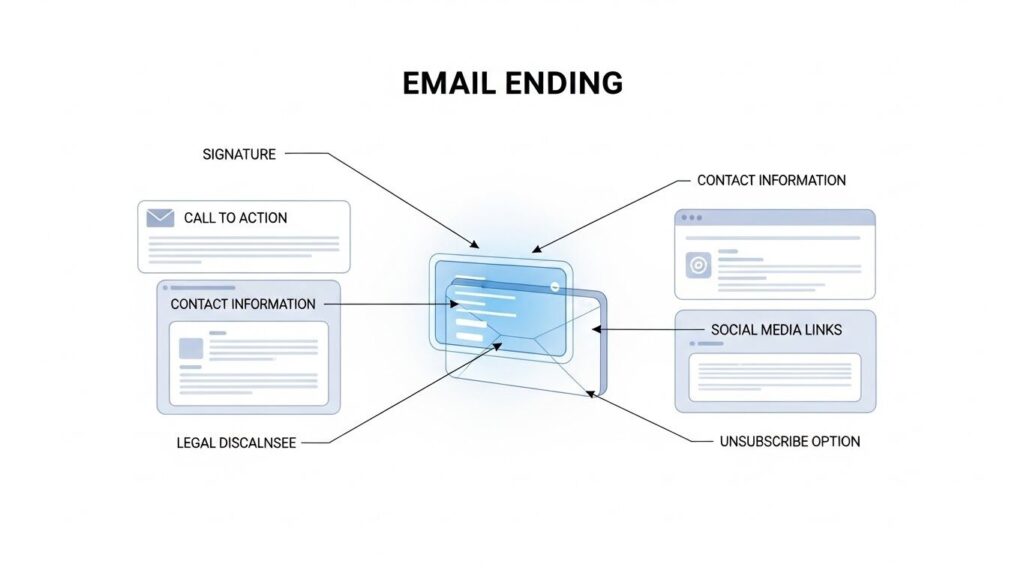
The closing is part of a larger structure at the end of your letter or email. A complete closing section typically includes:
- The Closing Line: A final sentence that wraps up the message (e.g., “I look forward to hearing from you.”).
- The Complimentary Closing (Valediction): The chosen sign-off phrase (e.g., “Sincerely,”).
- Your Signature: Your typed name.
- Your Contact Information (in emails): Your title, company, phone number, and website.
Here’s an example of a formal email ending:
Thank you for your time and consideration. I look forward to discussing this opportunity further.
Sincerely,
Jane Doe
Marketing Manager | ABC Corporation
(123) 456-7890 | jane.doe@abccorp.com
And an informal example:
Let me know if you have any thoughts on this.
Cheers,
John
Conclusion: The Final Word on Closings
The opposite of a salutation—the closing or valediction—is a small but powerful component of written communication. It’s the final note you leave with your reader, and it plays a critical role in shaping their perception of you and your message.
By understanding the difference between formal letter endings, professional email sign-offs, and informal email closings, you can navigate any situation with confidence. Always consider your audience, the context of your message, and your relationship with the recipient. Choosing the right closing ensures your communication is not only effective but also polite, professional, and appropriate every time. So next time you’re about to hit “send,” take a moment to consider your closing. That final word matters more than you think.