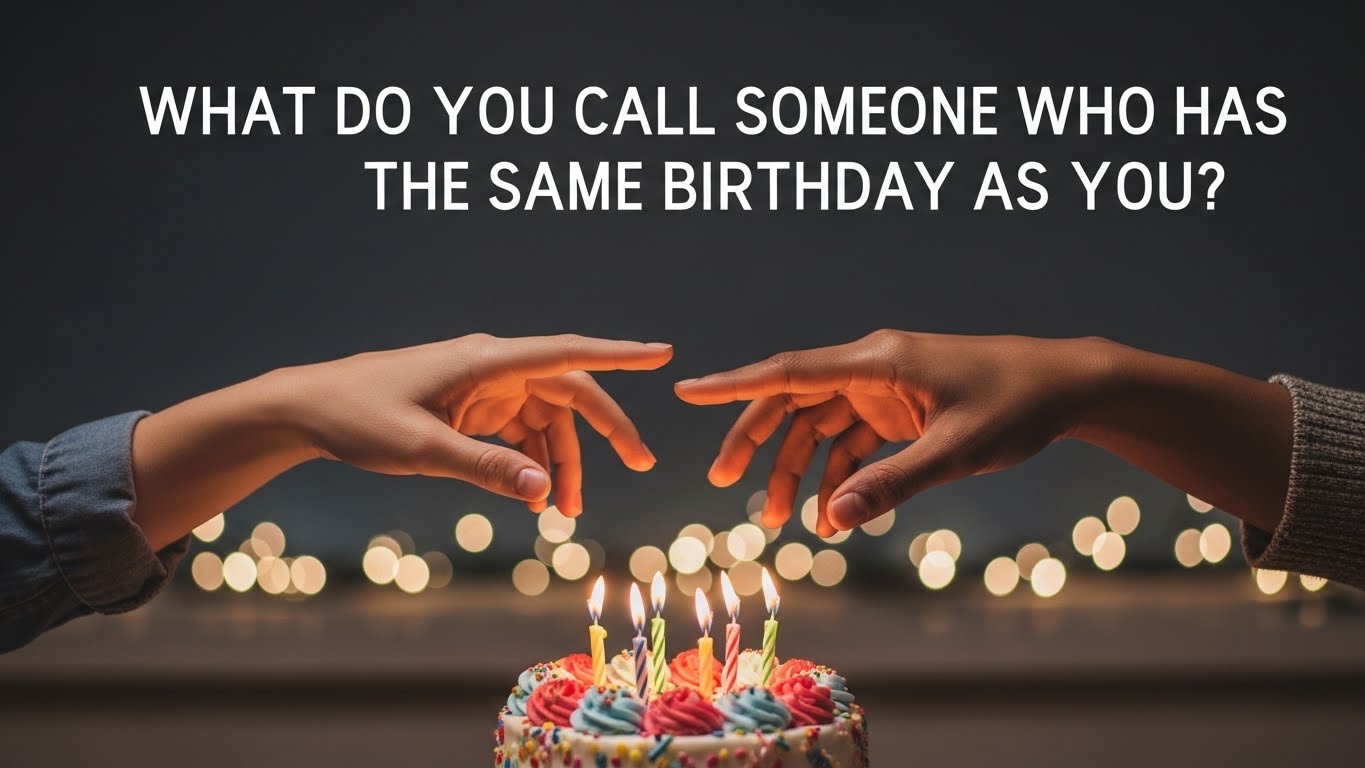
What Do You Call Someone Who Has the Same Birthday as You?
Finding out that you share a birthday with someone creates an instant spark. There is a sudden, inexplicable bond that forms when you realize you both blew out candles on the exact same day of the year. It feels like a cosmic wink, a small coincidence that suggests you might have more in common than just a date on the calendar. But what is the actual term for this connection? Is there a specific word in the English language that defines this relationship?
This article explores the vocabulary, psychology, and cultural fascination behind sharing a birthday. We will dig into the term “birthday twins,” explore the mathematical probability of these encounters, and discuss why this simple shared fact creates such a strong human connection.
Is There a Specific Word for Sharing a Birthday?
If you are looking for a single, dictionary-official word that means “someone who shares my birthday,” you might find the English language surprisingly lacking. Unlike “classmate” or “roommate,” we don’t have a formal noun like “date-mate” or “birth-mate” in standard usage.
However, language evolves to fill gaps, and several terms have emerged to describe this specific relationship.

The Most Common Term: Birthday Twins
By far, the most widely accepted term is birthday twins. When people discover a shared date of birth, they almost instinctively exclaim, “We are birthday twins!”
This term doesn’t imply you are biologically related or even born in the same year. It simply highlights the twin-like connection of celebrating your existence on the same annual rotation. It is a term of endearment and camaraderie. Using “birthday twins” instantly softens social barriers and creates a sense of “us.”
Other Terms and Variations
While “birthday twins” takes the crown, you might hear other variations depending on the context:
- Birthday Counterpart: A more formal way to describe the person.
- Astrotwin: This is popular in astrology circles. It specifically refers to someone born on the same day and year (and sometimes same time and place), meaning you share an identical natal chart.
- Birthday Buddy: Often used in workplaces or schools to group people celebrating in the same month or week.
- Co-Birthday: Used as an adjective or descriptor, as in “my co-birthday friend.”
The Mathematics of the Birthday Coincidence
You might think meeting someone with your exact birthday is a rare, mystical event. However, mathematics tells a different story. This phenomenon is so counter-intuitive that it has a famous name in probability theory: The Birthday Paradox.

What is the Birthday Paradox?
The Birthday Paradox (or Birthday Problem) states that in a random group of just 23 people, there is a roughly 50% chance that two people will share a birthday.
Most people struggle to believe this. Since there are 365 days in a year (366 in a leap year), it feels like you would need a massive crowd to find a match. But the math focuses on pairs of people, not specific dates. In a room of 23 people, you aren’t just comparing everyone to you; you are comparing everyone to everyone else. The number of possible pairs grows exponentially as the group size increases.
By the time you get to a group of 75 people, the probability of a shared birthday reaches 99.9%.
Why Does It Still Feel Special?
Despite the math proving it is likely, finding a birthday connection still feels magical. Why? Because from your individual perspective, it is rare. You aren’t looking for any match in the room; you are looking for a match with you.
The odds of meeting someone who shares your specific birthday are roughly 1 in 365 (0.27%). That low percentage makes the encounter feel significant, personal, and destined, regardless of what the statisticians say.
The Cultural Significance of a Shared Birthday Meaning
Across different cultures and eras, sharing a birthday has carried various weights of meaning. It is rarely treated as just a data point; humans love to attach significance to time.
Astrology and “Astrotwins”
In the world of astrology, a shared birthday meaning goes deep. If you share a birthday (just the day and month), you share a Sun Sign. This implies you share basic personality traits, ego drives, and general approaches to life.
However, if you meet someone born on the same day, month, and year, astrologers call this an “Astrotwin” or “Time Twin.” The belief is that your lives will run on parallel tracks. You might experience major life milestones—marriage, career shifts, personal challenges—at similar times because the planetary transits affecting your charts are identical.
Many people enjoy comparing notes with their astrotwins to see if these synchronicities hold up. “Did you also have a rough 2019?” or “Did you also get promoted last month?” are common questions among these pairs.
Historical Perspectives
In some ancient cultures, being born on the same day as a leader or a deity was seen as an auspicious omen. It could signify that the child was blessed or destined for a similar path of greatness. Conversely, in some superstitious traditions, sharing a birthday was seen as sharing a soul or spirit, leading to fears that one might steal the other’s luck.
Today, the superstition has largely faded, replaced by the fun of the coincidence. We treat it as a bonding mechanism rather than a mystical omen.
Celebrity Birthday Twins: A Modern Obsession
One of the most popular internet pastimes is searching for celebrity birthday twins. Who doesn’t want to know they share a big day with a movie star or a historical icon?
Websites and databases are dedicated entirely to this same birthday term search. Discovering you were born on the same day as Albert Einstein or Beyoncé allows you to borrow a little bit of their shine. It provides a fun icebreaker and a bit of trivia about yourself that is easy to remember.
Sharing a birthday with a celebrity can also create a sense of kinship. You might find yourself rooting for that actor or politician simply because you feel a loyalty to your shared date. It is a prime example of the “mere ownership effect”—we value things (and people) more simply because they are associated with us.
The Psychology of the Bond
Why do we get so excited about meeting a stranger with the same birthday? It comes down to our fundamental need for connection and similarity.
Implicit Egotism
Psychologists refer to a concept called “implicit egotism.” Essentially, humans have an unconscious preference for things that remind them of themselves. We are more likely to live in cities that start with the same letter as our name, choose careers that sound like our names, and like people who share our characteristics.
Your birthday is a core part of your identity. It is one of the first things you learn about yourself as a child. When you meet someone who mirrors that core identity marker, your brain signals safety and familiarity. You instantly like them a little more because they are “like you.”
Breaking the Ice
A birthday coincidence is the ultimate social lubricant. It cuts through the awkwardness of small talk. Instead of discussing the weather, you are discussing a personal fact.
- “What day were you born?”
- “October 12th.”
- “No way! Me too!”
Suddenly, the dynamic shifts. You high-five. You laugh. You have a shared secret. This shared status creates a “we” group in a room full of “thems.” It is a shortcut to intimacy that few other random facts can provide.

Famous “Birthday Twins” in History
History is full of strange coincidences where famous figures share birth dates, or even birth and death dates.
- Abraham Lincoln and Charles Darwin: Both of these monumental figures were born on the exact same day: February 12, 1809. While one was reshaping American politics and abolishing slavery, the other was across the ocean formulating the theory of evolution. They changed the world in completely different ways, yet their lives began in the same 24-hour window.
- Margaret Thatcher and Lenny Bruce: The “Iron Lady” of British politics and the controversial, counter-culture comedian shared a birthday (October 13, 1925). It is a hilarious reminder that a shared birthday does not guarantee a shared personality or ideology.
- William Shakespeare: The Bard is famously believed to have died on his birthday, April 23, 1616. While his exact birth date is an estimate based on baptism records, the symmetry of birth and death on the same date remains a poetic legend.
How to Celebrate with Your Birthday Twin
If you are lucky enough to have a close friend, partner, or family member who is also your birthday twin, you have a unique opportunity for celebration. However, it can also lead to logistical challenges. Who gets to pick the cake? Whose dinner choice wins?
Joint Parties
The most obvious solution is the joint party. This can be fantastic for pooling resources to throw a bigger bash. The key to a successful joint party is ensuring both people feel honored.
- Two Cakes: Never make birthday twins share a single cake unless they insist. Everyone deserves their own candles to blow out.
- Individual Toasts: Ensure speeches or toasts acknowledge each person individually, rather than lumping them together as a unit.
The “Birthday Week” Compromise
If you both have strong opinions on how to celebrate, split the week. One person takes the actual day for their preferred activity, and the other takes the following Saturday. Or, alternate years for who gets to choose the “main event.”
The Unique Connection
For romantic partners who share a birthday, the day becomes doubly special. It is an anniversary of life for both. Couples often joke that it saves money on gifts or makes the date impossible to forget. It simplifies the calendar but amplifies the pressure to make that one day perfect for both parties.

Unusual Birthday Facts and Trivia
To arm you with more knowledge for your next birthday conversation, here are some fascinating facts about birth dates:
- The Most Common Birthday: In the United States, September 9th is often cited as the most common birthday. This corresponds to conception occurring around the holiday season in December.
- The Least Common Birthday: Aside from February 29th (Leap Day), major holidays like December 25th and January 1st are among the least common birthdays. This is largely due to scheduled inductions and C-sections; doctors and parents often avoid scheduling births on holidays if possible.
- The Golden Birthday: This is another fun term. Your “Golden Birthday” is the year you turn the age of your birth date. For example, turning 25 on the 25th of the month. It is considered a once-in-a-lifetime celebration.
Conclusion
So, what do you call someone who has the same birthday as you? While the dictionary may not offer a formal noun, culture has given us the perfect term: Birthday Twins.
Whether you call them your birthday counterpart, your astrotwin, or just your lucky connection, finding someone who shares your day is a delightful quirk of life. It defies our intuition about odds, triggers our psychological desire for connection, and provides a fun story to tell at parties.
The next time you meet someone and discover that shared date, lean into the excitement. It is a reminder that in a world of billions, we are always looking for the small threads that tie us together.
Key Takeaways
- “Birthday Twin” is the most socially accepted and recognized term for someone sharing your birthday.
- The Birthday Paradox proves that shared birthdays are mathematically much more common than they feel.
- Psychology explains that we like birthday twins because of “implicit egotism”—we prefer things associated with ourselves.
- Astrotwins are those born on the same date and year, often believed to share life paths in astrology.
- Celebration etiquette suggests that even “twins” deserve their own cake and individual recognition.