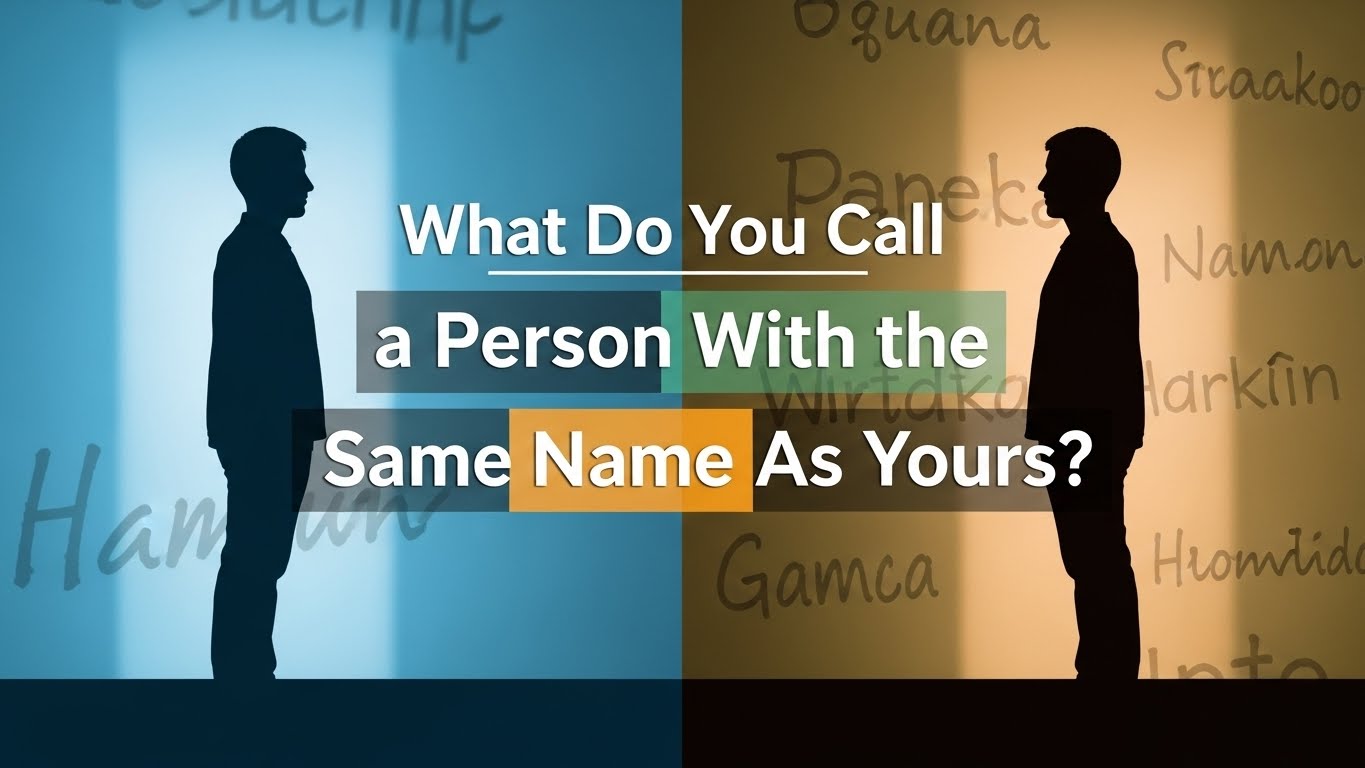
What Do You Call a Person With the Same Name As Yours?
You are at a coffee shop, waiting for your morning latte. The barista calls out your name. You step forward, hand outstretched, only to bump into someone else doing the exact same thing. You both freeze, look at each other, and laugh. “Same name!” one of you says. It is a funny, slightly awkward moment of connection. But it begs the question: What is the proper term for this person? What do you call a person with the same name as yours?
The most common answer is “namesake,” but the reality of shared names is far more interesting than just one word. From ancient traditions to modern internet slang like “name twins,” sharing a moniker creates a unique bond. This article explores the linguistic, cultural, and social dimensions of bumping into your linguistic doppelgänger.
The Definitive Answer: Meeting Your Namesake

If you are looking for the dictionary-perfect term, “namesake” is your answer. It is the standard English word used to describe two people who share the same name.
Namesake Meaning and Usage
The word namesake has a rich history. It dates back to the mid-17th century, derived from the phrase “for the name’s sake.” Originally, it implied a specific relationship. If you named your child after your grandfather, the child was the grandfather’s namesake. The name was given for the sake of the elder relative.
However, language evolves. Today, the definition has broadened significantly. You do not need to be named after someone to be their namesake. If you are a ‘Michael’ and you meet another ‘Michael’ at a party, you are namesakes.
While some purists might argue that the term strictly applies to the person receiving the name (the junior party), general usage treats it as a reciprocal relationship. You are both namesakes to one another.
Is There a Difference Between “Namesake” and “Named After”?
This is a common point of confusion.
- Named After: This implies intent. If your parents loved the singer Elvis Presley and gave you his name, you were named after him. He is the inspiration; you are the result.
- Namesake: This describes the status of sharing the name, regardless of intent. You might be named after your grandmother (making you namesakes), or you might share a name with a stranger on the bus (also namesakes).
Beyond the Dictionary: “Name Twins” and Modern Slang

Language is rarely static, especially in the digital age. While “namesake” is formal and correct, it can sometimes feel a bit stiff for casual conversation. Enter the world of modern slang and affectionate nicknames for your same-name person.
The Rise of “Name Twins”
In the era of social media, “name twins” has become a popular term. It mirrors the concept of “birthday twins” (people born on the same day). It is lighthearted, fun, and implies a sudden, random connection.
Imagine finding someone on Instagram who has your exact first and last name. You might comment, “Hey, name twin!” It is a quick way to acknowledge the coincidence without the formal weight of “namesake.”
The “Name Doppelgänger”
For a more dramatic flair, some people use “name doppelgänger.” A doppelgänger is traditionally a look-alike, often with a ghostly or eerie connotation. Applying this to names adds a layer of mystery. It suggests that this other person is living a parallel life to yours, just with the same label.
This term is particularly relevant when you Google yourself. Finding a “name doppelgänger” who is famous, infamous, or just wildly different from you can be a jarring experience. If you are a quiet librarian named Jennifer Lopez, your digital life is forever shadowed by your celebrity name doppelgänger.
Cultural Perspectives on Shared Names
How we treat a same name person varies wildly across different cultures. In some places, it is a great honor; in others, it is a strict taboo.
The Western Tradition: Juniors and Seniors
In many Western cultures, specifically in the United States and the United Kingdom, passing down a name is a way to preserve lineage. This creates the “Junior” (Jr.), “Senior” (Sr.), and numerical suffixes (III, IV).
In this context, being a namesake carries the weight of family history. A “Junior” is walking around with a living legacy attached to their identity. It creates a very specific dynamic where the shared name is not a coincidence but a deliberate tether between generations.
The Ashkenazi Jewish Tradition
In contrast, Ashkenazi Jewish tradition historically views naming a child after a living relative as bad luck. The superstition suggests that the Angel of Death might get confused and take the younger person instead of the older one, or that the older person must die to “make room” for the name to be passed on.
Therefore, you will rarely find a Junior in these families. Instead, children are named after deceased relatives to honor their memory. In this culture, meeting a living namesake within the family is rare and avoided, whereas meeting a stranger with the same name is just a coincidence.
Asian Perspectives
In many East Asian cultures, names are chosen based on complex factors including the time of birth, the number of strokes in the characters, and family generational poems. While surnames (like Li, Wang, Sato, or Kim) are shared by millions, sharing a full name can be seen differently.
In China, for example, having a rare name is often desired to stand out. Meeting someone with your exact full name might be seen as surprising given the vast number of character combinations available. However, popular names do exist, and “name twins” are becoming more common in urban centers.
The Psychology of the Shared Name
Why do we care so much when we meet someone with our name? It is just a word, after all. But psychologists suggest that our names are deeply tied to our sense of self.
The “Name-Letter Effect”
We tend to prefer the letters in our own name. This is called the “name-letter effect.” We are subconsciously drawn to people, places, and even careers that share our initials or sounds. When we meet a whole person who shares our whole name, it triggers an intense version of this affinity. We instantly feel a sense of camaraderie or curiosity about them.
Identity Crisis?
On the flip side, sharing a name can trigger a minor identity crisis. We like to think of ourselves as unique individuals. Meeting another “Sarah Jenkins” challenges that uniqueness. It forces us to realize that our identifier is not exclusive.
This is often played out in the professional world. If you are a writer, artist, or public figure, having a “same name person” in the same industry can be a nightmare for branding. You are no longer just “The John Smith”; you are “The other John Smith.”
Practical Scenarios: When Namesakes Collide
The phenomenon of the shared name leads to some practical, and often hilarious, situations.
The Email Mix-Up
In the corporate world, the “same name person” is a common source of chaos. If your company hires another person with your name, IT departments usually resort to clunky email addresses like john.smith2@company.com.
This leads to the inevitable “wrong inbox” scenario. You might receive confidential documents meant for your namesake, or worse, their party invites. It forces a strange relationship where you become the gatekeeper of each other’s digital lives.
The “No Fly List” Problem
Having a shared name can stop being funny when you travel. If your namesake has a criminal record or is on a government watch list, you might find yourself detained at customs. This is a well-documented issue for people with common names. In this case, your “name twin” becomes a source of significant frustration rather than amusement.
Social Media Tagging
We have all seen it: a birthday post where the wrong friend is tagged. If you share a name with a mutual friend in a social circle, you will likely spend a lifetime correcting tags in photos you are not in. It is a modern tax on having a common name.
Famous Namesakes and Historical Confusions

History is littered with people who share names, leading to centuries of confusion for students and historians alike.
- The Cromwells: Thomas Cromwell and Oliver Cromwell are often confused by those with a passing interest in British history, though they lived a century apart and had very different roles.
- The Roosevelts: With two Presidents named Roosevelt (Theodore and Franklin), the distinction is often blurred, though they were distant cousins.
- The Hollywood Chris Club: In pop culture, we have Chris Evans, Chris Pine, Chris Hemsworth, and Chris Pratt. While not full namesakes, their shared first name and similar industry standing have turned them into a cultural meme about the interchangeability of leading men.
What To Do When You Meet Your Namesake
So, you have bumped into someone with the same name. What is the etiquette?
- Acknowledge It: Do not ignore it. It is too big of a coincidence to let slide. A simple smile and a “Great name!” is the standard icebreaker.
- Establish a Nickname: If you are going to be in the same social circle or workplace, establish dominance—or compromise—early. Who gets to keep the name, and who becomes “J.D.” or “Big Mike”?
- Check the Spelling: Nothing ruins the bond faster than realizing one of you is a “Sean” and the other is a “Shawn.” You are close, but you are not true text-based name twins.
- The “Highlander” Joke: It is almost mandatory to make a reference to the movie Highlander: “There can be only one.” It is a cliché, but it works every time.
Alternate Terms in Other Languages
While English relies heavily on “namesake,” other languages have their own specific terms for this phenomenon.
- Spanish (Tocayo/Tocaya): This is perhaps the most widely used specific term for a namesake. In Mexico and many parts of Latin America, calling someone “mi tocayo” is a warm, friendly way to address them. It creates an instant bond, almost like calling them “cousin” or “brother.”
- German (Namensvetter): This translates directly to “name-cousin.” It captures the familial feeling of sharing a name, even if you are not related by blood.
- French (Homonyme): The French often use the word for “homonym.” While technically correct (words that sound the same), it feels a bit more clinical than the warmth of tocayo.
The Evolution of Naming and Future Namesakes
As naming trends shift, the likelihood of meeting a namesake changes.
The Decline of the “Johns” and “Marys”
Decades ago, a classroom might have five Davids and four Jennifers. Today, parents are prioritizing uniqueness. They are inventing spellings or choosing obscure nouns as names. This means the next generation might have fewer “namesake” moments than previous ones.
If your name is “Khaleesi” or “Maverick,” meeting a namesake is a rare and startling event. It signifies a very specific cultural moment in time (the release of a show or movie) rather than a family tradition.
The Global Village
However, globalization increases the chances of cross-cultural namesakes. A name like “Maya” exists in Sanskrit, Hebrew, Greek, and Spanish. A “Hana” can be Japanese, Arabic, or Czech. In a globalized world, you might find your “name twin” in a country you have never visited, bridging cultures through a shared sound.
Conclusion: The Bond of the Shared Name
So, what do you call a person with the same name as yours? You call them your namesake. You might call them your tocayo, your name twin, or perhaps your doppelgänger.
Regardless of the term you choose, sharing a name is a unique human experience. It is a reminder that while we strive for individuality, we are all connected by the limited pool of language we use to identify ourselves.
The next time you meet someone who shares your name, do not just gloss over it. Embrace the coincidence. It is a small, momentary connection in a big world—a sign that you are not the only one walking around with that specific label. And if nothing else, you know for a fact that they have excellent taste.
Frequently Asked Questions
Q: Is it bad luck to meet your namesake?
A: Generally, no. Most cultures view it as a funny coincidence or a sign of good connection (like the Spanish tocayo). However, some specific family traditions avoid naming children after living relatives due to superstition.
Q: Can a thing be a namesake?
A: Yes! A building, a ship, or a park can be a namesake if it is named after a person. For example, the Ford Mustang is not a namesake of a horse, but if a library is named the “Kennedy Library,” it is a namesake of the Kennedy family.
Q: What is the difference between a namesake and an eponym?
A: An eponym is the person, place, or thing that something else is named after. If you are named after your grandfather, he is the eponym. You are the namesake. However, in casual usage, “namesake” is often used for both parties.
Q: How do you address a namesake in an email?
A: Humor is usually the best approach. Starting with “Hello, fellow [Name]” acknowledges the situation immediately and breaks the ice.